SEO vs AEO: what’s the difference, and which one does your business actually need?
📌 Key points
- SEO gets your page into Google’s list of blue links. AEO gets your business named inside the single answer an AI tool reads back. Different target, different work.
- They share a foundation. A site that’s slow, messy, or vague loses at both, so good SEO habits feed your AEO rather than competing with it.
- AEO is closer to all-or-nothing. There’s no page two of an AI answer, so if a competitor gets named and you don’t, you’re simply absent from that decision.
- Ranking number one on Google no longer guarantees the AI quotes you. The two systems judge content differently.
- For most small businesses the honest answer is both, with the emphasis decided by where your site is weakest right now.
Difference Between Seo and Aeo . what each one does, how they differ, whether AEO replaces SEO, and which your small business should focus on first.
You’ve probably been doing SEO for years, or paying someone to. Now every newsletter in your inbox is shouting about AEO, and it’s not clear whether this is a genuinely new thing you have to learn, a replacement for the work you already do, or just an old idea wearing a new acronym. I get why it’s confusing. Most of the explanations out there are written for marketing teams with a budget and a strategy deck, not for the person actually running the business and trying to decide where an hour of their time should go.
So here’s the plain version, the one I’d give a client over a call. SEO helps your website show up in a list of search results. AEO helps your business get named in the single answer an AI tool gives back. They’re related, they lean on the same foundation, but they’re aiming at two different things. And in 2026, most businesses I talk to need both, whether they realise it yet or not.
Table of Contents
What is SEO, in plain terms?
Search engine optimization is the work of setting up your website so it ranks well in the normal search results, the list of blue links you get from Google or Bing. The goal is a good spot in that list so people click through to you. It leans on keyword research, links from other sites, fast-loading pages, and a clean structure Google can read.
SEO has been the backbone of getting found online for twenty years, and it isn’t going anywhere. It’s still how a search engine finds your pages, works out what they’re about, and decides where to rank them. If you’ve ever written a blog post hoping to pull in visitors, or paid someone to “improve your Google rankings,” you’ve been doing SEO whether you called it that or not.
What does SEO reward?
At heart, it rewards two things: relevance and trust. The search engine tries to work out which page best answers a query, and which sites are credible enough to put in front of people. It reads the words on your page, looks at who links to you, checks how fast you load, and sees how easily it can crawl your content. Do that well and you climb. The prize is a position, and from that position, a click.
What is AEO, in plain terms?
Answer engine optimization is the work of setting up your content so AI tools actually use it when they answer a question. Instead of fighting for a spot in a list, you’re trying to be the source the AI quotes when someone asks about your field. The win isn’t always a click. It’s a citation, a mention, your business named inside the answer itself.
The work focuses on making your content easy for a machine to lift cleanly: answer the question in the first line or two, write your headings as questions, add a real FAQ, and label your content with structured data so the AI knows exactly what it’s looking at. Where SEO asks “how do I rank this page,” AEO asks “how do I become the answer.”
Which tools are we even talking about?
When people say “answer engines,” they mean the AI tools your customers increasingly reach for first. The assistants that hand back a written answer instead of a list, and the AI summaries now sitting at the top of Google’s own results. The thing they have in common is that they give one answer, pulled from sources they’ve decided to trust. AEO is the work of becoming one of those trusted sources.
So what’s the actual difference between SEO and AEO?
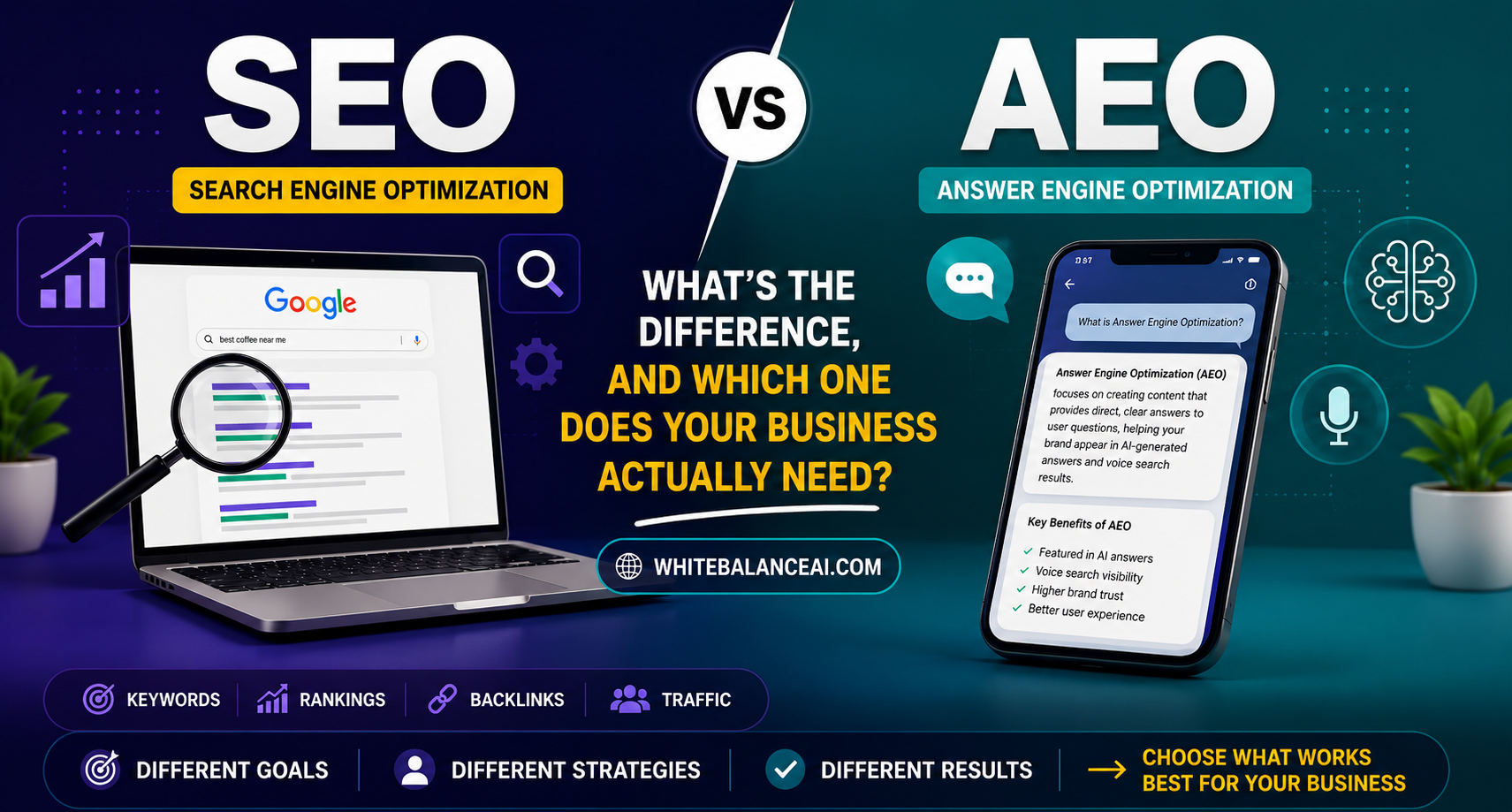
The cleanest way to hold it in your head: SEO is built to rank a page, AEO is built to be picked as part of an answer. That one distinction spreads out into everything else, the goal, the way you write, and how you measure whether it’s working. Let me take those one at a time, because the difference between SEO and AEO is easiest to feel through its consequences.
The outcome is different
SEO earns you a position in a list. First, fifth, somewhere on page one, but either way the person still chooses which link to click. AEO earns you a mention inside one answer the AI has already written. There’s no list to pick from. The AI names a source, or it doesn’t. One gives you a shop window on a busy street. The other gets you named when someone asks a friend who they’d recommend.
The stakes are different
This is the part that catches people off guard. With old-school search, landing on page two still got you a sliver of traffic. AI answers are closer to all-or-nothing. If the assistant names a competitor and skips you, you’re just not in that person’s decision at all. There’s no page two of an AI answer to scroll to. That’s the bit that should make you sit up: the difference between SEO and AEO here is the gap between a quiet ranking and total invisibility.
The way you measure is different
SEO success shows up in rankings and clicks, numbers you can watch tick up in a dashboard. AEO success shows up as whether you get named when someone asks an AI a question you should own. Your normal rank tracker won’t show any of that, so measuring AEO means going and checking the answers yourself, by asking the tools directly. It’s a different kind of scorekeeping, and most businesses haven’t adjusted to it yet.
SEO vs AEO, side by side
| SEO | AEO | |
|---|---|---|
| Goal | Rank in a list of links | Get cited in a direct answer |
| Where it shows | Google and Bing results pages | AI assistants and AI search summaries |
| What you get | A click to your site | A mention, quote, or recommendation |
| How you write | Thorough, keyword-aware pages | Answer-first, question headings, FAQs |
| How you measure | Rankings and click numbers | Whether you get named in answers |
The table makes the contrast obvious, but the more useful point is strategic: the content that actually wins in 2026 usually does both at once. It answers the main question in plain language up top, then keeps going into the detail and examples that a thorough reader, and a search engine, both want to see.
Do SEO and AEO share anything?
More than you’d think, which is the reassuring bit. The same things that make a page rank well also tend to make it easy for an AI to read and quote: clear structure, sensible headings, fast loading, and content that genuinely answers the question instead of dancing around it. Strong SEO fundamentals quietly hold up your AEO, and weak ones drag both down. If your site is confusing, slow, or vague, neither a search engine nor an AI is going to trust it.
That shared base is why I don’t think of SEO and AEO as rivals. They’re two layers of the same job. The groundwork you lay for one mostly serves the other, so the work is far less duplicated than the two separate buzzwords make it sound.
Will AEO replace SEO?
No, and if you’ve spent years on SEO, this is the line to hold onto. SEO is still the layer underneath everything. An AI can’t cite a page it can’t find or read in the first place. AEO sits on top of that foundation and adapts it for a world where people get one answer instead of ten links. The strongest setup right now does both, treating SEO as the base and AEO as the layer that makes the base pay off in front of an AI.
What does this look like with a real example?
Picture someone who wants help eating in a more gut-friendly way and types a question about it. In the SEO world, they Google it, get ten links, and click one or two that look promising. Your page is fighting for one of those clicks against nine others. In the AEO world, they ask an AI assistant the same thing and get back one written answer that names a couple of trusted sources. If your content is built to be quoted, you’re one of those names. If it isn’t, you’re invisible, even if that exact page would have ranked perfectly fine in the old list.
That’s the difference between SEO and AEO made concrete. Same person, same question, two completely different ways of being found, or missed. SEO fought for attention inside a list. AEO fights to be the answer itself. Both still matter, because some of your customers are still scrolling lists while a growing number have quietly stopped.
Can’t I just rely on my good Google rankings?
I wish, but no. A strong Google ranking doesn’t automatically make you the AI’s answer. The two systems overlap, but they judge content in different ways. A page can rank beautifully and still be a mess to extract from, with the answer buried in paragraph four and headings that say nothing. When that happens, the AI just reaches past you for a cleaner source. This is the trap a lot of established businesses fall into. They assume their search wins carry over, and only notice much later that the AI keeps recommending someone else.
What mistakes do people make when they blur the two?
Treating SEO and AEO as the same thing leads to a few predictable mess-ups. Naming them is the easiest way to dodge them.
- Assuming rankings equal AI visibility. A top Google spot doesn’t guarantee a single AI citation. They’re scored differently, and one doesn’t hand you the other.
- Dropping SEO to chase AEO. Some owners hear “AI is the future” and let their foundations rot. Without SEO, the AI can’t find or read you, so the AEO work has nothing to stand on.
- Writing long and hoping. Rambling pages might have suited old habits, but AEO needs the answer up front. Content that won’t get to the point rarely gets quoted.
- Measuring AEO with SEO tools. A rank tracker won’t tell you whether an AI names you. Watch only rankings and you miss the signal that actually matters here.
Every one of those comes from smudging the line between SEO and AEO. Keep them distinct in your head, same foundation, different target, and you sidestep all four.
Which one does your business need?
For nearly every small business I work with, the honest answer is both. But the emphasis depends on where you’re starting. If your foundations are shaky, fix the SEO basics first, because AEO has nothing to build on without them. A fast, clearly structured, crawlable site is the price of entry. If your foundations are already solid but you’re nowhere in AI answers while competitors are showing up, then AEO is where your attention should go.
Here’s a quick test you can run in two minutes. Ask an AI tool a question you’d love to be the answer to. If a competitor comes up and you don’t, you’ve just found your priority. If nobody in your field comes up clearly, you’ve found an open door, and the difference between SEO and AEO there is the difference between elbowing into a crowded list and walking into an empty answer.
How do you start doing both well?
Start with content that answers real questions clearly, structured so a search engine and an AI can both make sense of it. Write the way your customers actually ask. Lead with the answer. Add a genuine FAQ. Keep the site fast and the structure clean. Those habits feed SEO and AEO at the same time, which is the most efficient way for a small business to work, one effort with two payoffs.
Frequently Asked Questions
Is AEO just a new name for SEO?
No. Although AEO and SEO share the same foundation, they target different outcomes. SEO aims to rank your pages in traditional search results, while AEO helps your content become the direct answer cited by AI-powered search engines and assistants. Most businesses benefit from using both together.
Will AEO replace SEO?
No. SEO remains the foundation because AI systems cannot reference pages they cannot discover or understand. AEO builds on strong SEO by optimizing content for answer-first experiences. The two strategies work together rather than replacing one another.
If I do good SEO, will I automatically show up in AI answers?
Not necessarily. Strong SEO improves your chances because well-structured pages are easier for AI systems to understand. However, appearing in AI-generated answers usually requires additional AEO techniques such as answer-focused writing, question-based headings, FAQs, and structured data.
Which should a small business focus on first?
If your website has technical or content issues, start by strengthening your SEO foundation. Once your site is well optimized, focus on AEO to improve your visibility in AI-generated answers and conversational search experiences.
How do I measure AEO if my rank tracker doesn’t show it?
The simplest approach is to ask AI platforms the questions your business should answer and check whether your website or brand is referenced. This provides a more meaningful measure of AEO success than traditional rankings alone.
Not sure whether your site needs SEO, AEO, or both?
This is exactly the kind of thing I sort out for small businesses, working out where your site is losing visibility, fixing the foundations so search engines rank you, and restructuring your content so AI tools actually quote you. If you’d rather not untangle schema, headings, and crawler files yourself, I can handle it for you.
👉 Run a free site check
💬 Want me to do the work? Message me on WhatsApp
👋 About the Author
I’m Urmi Banerjee, founder of WhiteBalanceAI. I deploy high-performance websites and automated workflows using modern low-code infrastructure. If you’re looking to optimize your digital platform for the AI Search Era—including ChatGPT, Perplexity, Google AEO, and other AI-powered search experiences—or build automated revenue systems that streamline lead generation and customer acquisition, let’s connect at WhiteBalanceAI.com. I handle the technical architecture and system integration so you can focus on growing your business.
Visit WhiteBalanceAI →⭐ Found this helpful? Add WhiteBalanceAI as your Google Preferred Source so these AI-search and WordPress guides show up more often for you. Set WhiteBalanceAI as a preferred source →
🌿 Want to see AEO in action?
Caloriematterss is a real-world niche food blog built with AEO (Answer Engine Optimization) and GEO (Generative Engine Optimization) principles from the ground up. Explore how structured recipes, FAQ schema, internal linking, and AI-friendly content work together in a live website.
Visit Caloriematterss →Both SEO and AEO start with a fast, well-structured site, and that starts with decent hosting. I build and host client sites on Hostinger because the setup is clean, the speed holds up, and the dashboard doesn’t fight you. If you’re setting up hosting, you can use my referral: Hostinger (referral code BYAURMIBAALS).