How to Do Off-Page SEO: Backlinks, Domain Authority, and Link Building That Actually Moves Rankings
📌 Key Points Of How To Do off-page SEO ?
The problem: Your on-page SEO is fine, but you’re stuck on page two or three because search engines don’t trust your site yet.
The fix: Learn how to do off-page SEO properly-earn quality backlinks from real, relevant sites, keep a natural do-follow/no-follow mix, and build authority instead of chasing volume.
Who it’s for: Solo business owners and small teams who want their site to rank in Google and get cited by AI answer engines.
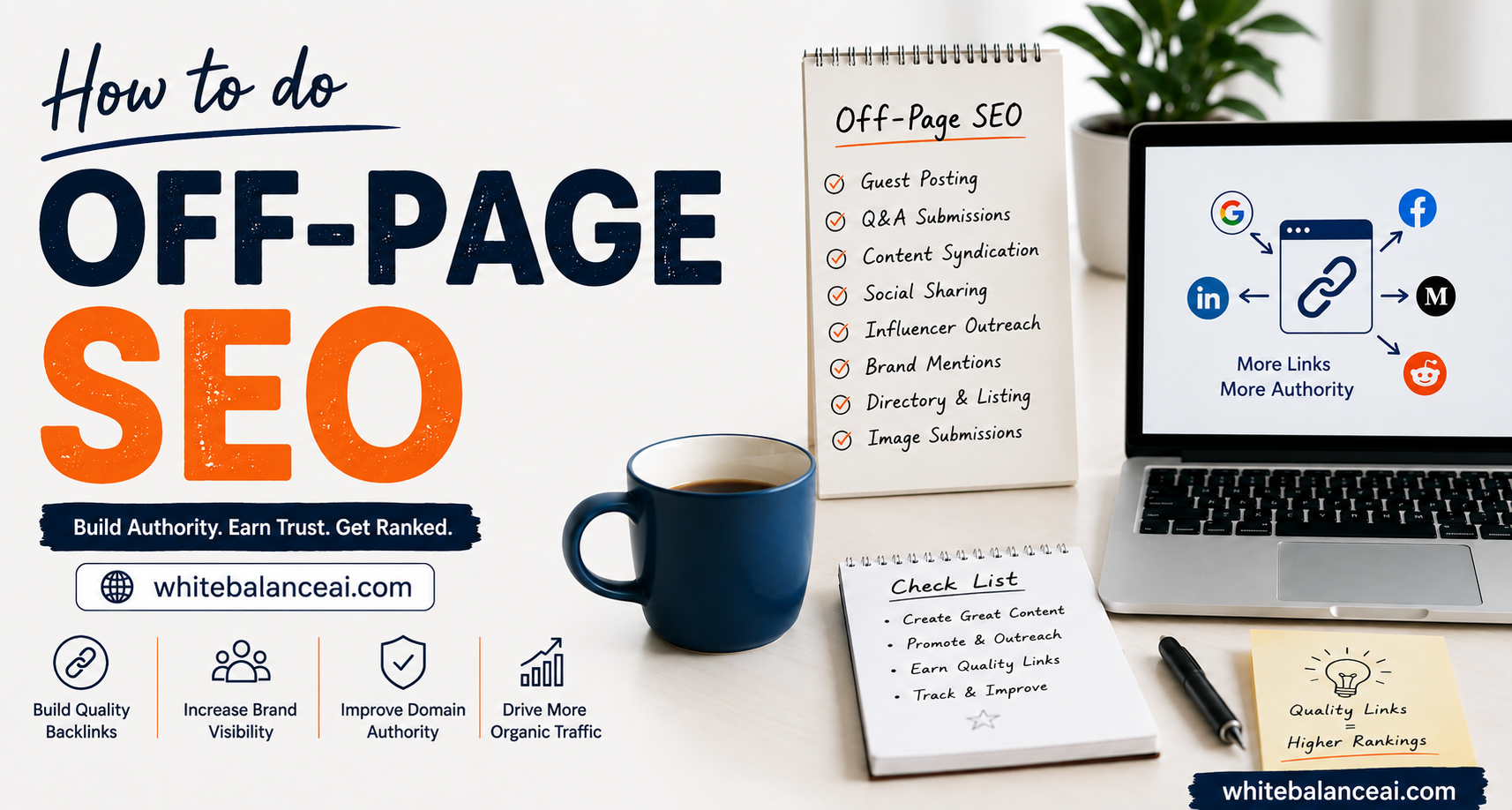
Off-page SEO is what search engines see about your website from the rest of the internet, and it’s usually the difference between a site that’s technically correct and a site that actually ranks. You can perfect every heading, meta tag, and keyword on your own pages and still sit on page three, because on-page work only proves you understand the topic. Off-page work proves other people trust you on it. This guide walks through how to do off-page SEO the way it actually works now: backlinks, do-follow versus no-follow, domain and page authority, the submission methods worth your time, and how to syndicate a post so it earns links instead of waiting for them.
Table of Contents
How do you do off-page SEO the right way?
The right way to do off-page SEO is to earn trust signals from other websites-mainly backlinks -from sources that are relevant and credible, at a natural pace, and to track what you build. It’s not about collecting as many links as possible; it’s about earning the right ones. The rest of this guide breaks down each piece: what backlinks are, how to tell a do-follow link from a no-follow one, which platforms are worth your time, how to syndicate a post, and how to keep it all safe from penalties.
What is off-page SEO, and why does it decide your rankings?
Off-page SEO is every signal about your site that lives somewhere other than your own domain. The biggest of those signals is the backlink: another website linking to yours. When a site links to you, it’s effectively vouching for you, and Google reads that vote as a reason to trust your content more.
Think of it like a reference for a job. Your CV is your on-page SEO-you control every word. But a strong reference from someone respected carries weight precisely because you didn’t write it. That’s what off-page SEO does. Knowing how to do off-page SEO well means earning the right references from the right places, not collecting as many as possible.
There’s an organic path and a paid path. Organic off-page SEO-guest posting, being genuinely useful in Q&A communities, earning mentions-is slower but durable. Paid link schemes are fast, risky, and the thing Google actively hunts for. This guide stays on the organic side, because that’s the version that survives an algorithm update.
What are backlinks, and how do they actually pass value?
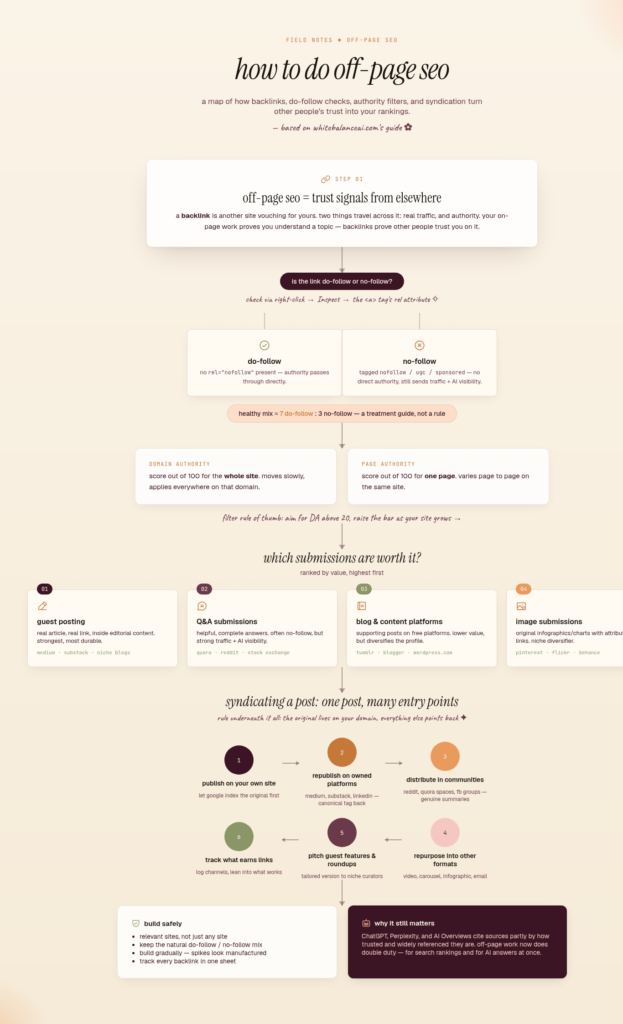
A backlink is simply a link from one website to another. If Website A publishes a link pointing to Website B, Website B has earned a backlink. Two things travel across that link: real human traffic and authority (the trust signal search engines pass along).
Not every backlink carries the same weight. A link from a well-known, relevant site in your field is worth far more than a link from a random directory nobody reads. This is the most common mistake I see when people first learn how to do off-page SEO-they treat 100 weak links as better than 10 strong ones. It’s the other way round. Relevance and trust beat raw quantity every time.
What’s the difference between do-follow and no-follow links?
Every backlink is either do-follow or no-follow, and the difference decides whether it passes SEO value.
- Do-follow links tell crawlers to follow the link and pass authority to the destination. These directly help your rankings.
- No-follow links carry a small tag (rel=”nofollow”) that tells crawlers not to pass authority. They don’t move rankings directly.
So should you ignore no-follow links? No-and this is where people get it wrong. A profile made entirely of do-follow links looks unnatural, because real websites earn a messy mix. Social platforms, forums, and many big publishers no-follow their outbound links by default. A healthy profile includes both. A rough working ratio is around 7 do-follow to 3 no-follow, but treat that as a sanity check, not a rule to force. No-follow links still send real traffic and still get your brand in front of AI crawlers.
How do you check if a link is do-follow or no-follow?
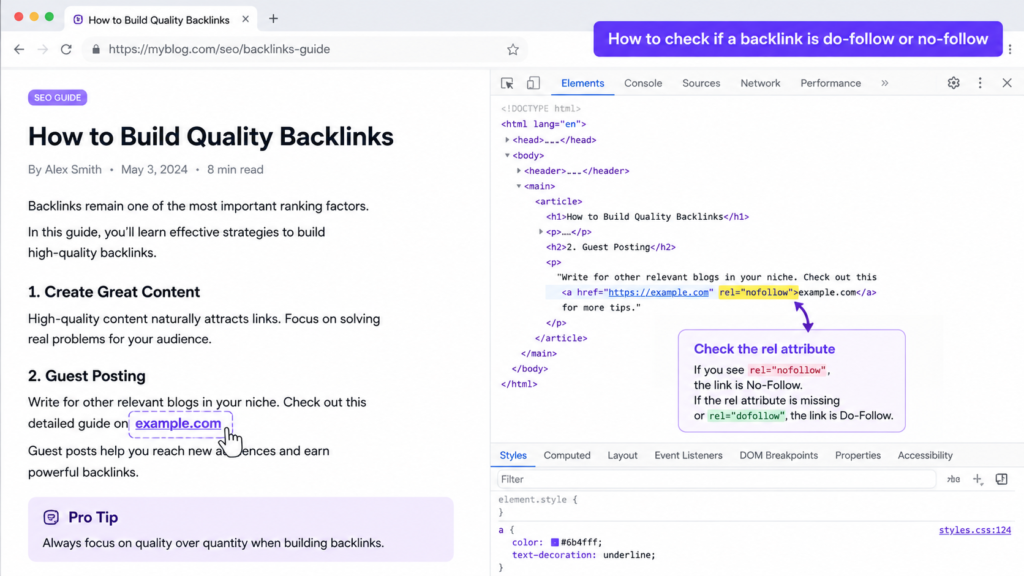
You can’t tell a do-follow link from a no-follow one just by looking at the page-they appear identical to a reader. The difference is hidden in the page’s HTML code, and you can check it in seconds using your browser’s Inspect tool. This matters because before you spend time earning a backlink from a site, you want to know whether that link will actually pass authority.
Here’s how to check any link, using a Tumblr post as an example:
- Open the post or page that contains the link you want to check.
- Right-click directly on the link (the blue clickable text) and choose Inspect from the menu.
- A code panel opens and jumps straight to that link’s HTML. Look for the line that starts with
<a href="...">. - Now read the
relattribute inside that tag:- If you see
rel="nofollow"(orrel="ugc"orrel="sponsored"), it’s a no-follow link-it won’t pass ranking authority. - If there’s no rel=”nofollow” at all-just a plain
<a href="yoursite.com">-it’s a do-follow link, and it passes authority.
- If you see
So the whole test comes down to one thing: does the link’s code contain rel="nofollow" or not? Present means no-follow, absent means do-follow. Do this check before investing effort in a platform, and you’ll know exactly what kind of link you’re earning. If you’d rather not inspect code every time, free browser extensions like NoFollow or MozBar highlight no-follow links on any page automatically.
How do you check if a backlink is do-follow or no-follow?
You don’t need a tool for this-your browser already shows you. Once you’ve placed a link somewhere (say a Tumblr post or a Quora answer), you can inspect it in a few seconds:
- Open the live page where your link appears.
- Right-click directly on your link.
- Choose Inspect (or Inspect Element). The browser opens its developer panel and highlights the exact HTML for that link.
- Read the
<a>tag, specifically therelattribute.
Here’s how to read what you see:
- If the tag contains
rel="nofollow"(orrel="sponsored"orrel="ugc"), it’s a no-follow link-no ranking authority passes through. - If there’s no
relattribute at all, or thereldoesn’t include “nofollow”, it’s a do-follow link -authority passes through.
One thing that trips people up: you’ll often see rel="noopener" or rel="noreferrer". Those are security attributes, not no-follow signals-a link can say noopener and still be fully do-follow. The only word that makes a link no-follow is nofollow. So don’t judge by whether a rel exists; judge by whether the word “nofollow” is inside it. This one check saves you from logging a link as valuable when it actually passes nothing.
Domain authority vs page authority: what’s the difference?
When you assess where to earn a backlink, two scores come up constantly, and confusing them wastes a lot of effort.
- Domain Authority (DA) is a score out of 100 estimating how much the whole website is trusted. It applies across the domain and moves slowly.
- Page Authority (PA) is a score out of 100 for a single page. It varies page by page.
DA stays roughly constant across a domain; PA changes depending on which specific page links to you. Both are third-party metrics from SEO tools, not Google’s own numbers, so use them as a rough filter. A practical starting rule when learning how to do off-page SEO: aim for links from domains with a DA above 20, and rise from there as your own site grows.
Which backlink submissions are actually worth doing?
Not all link-building tactics deserve equal effort. Here are the ones that still earn their keep, roughly in order of value:
Guest posting
Writing a genuine article for another relevant blog in your niche, with a link back. This is the strongest sustainable method because the link sits inside real editorial content on a topically relevant site. One good guest post outperforms dozens of directory submissions. Find guest-post opportunities on Medium, Substack, HubPages, and niche industry blogs, or use search strings like “your topic + write for us”.
Q&A submissions
Answering real questions with a helpful, complete answer that links back where genuinely useful. The link is often no-follow, but the referral traffic and AI-engine visibility make it worthwhile. Add a relevant image to lift engagement. Best platforms: Quora, Reddit, Stack Exchange, and Answers.com.
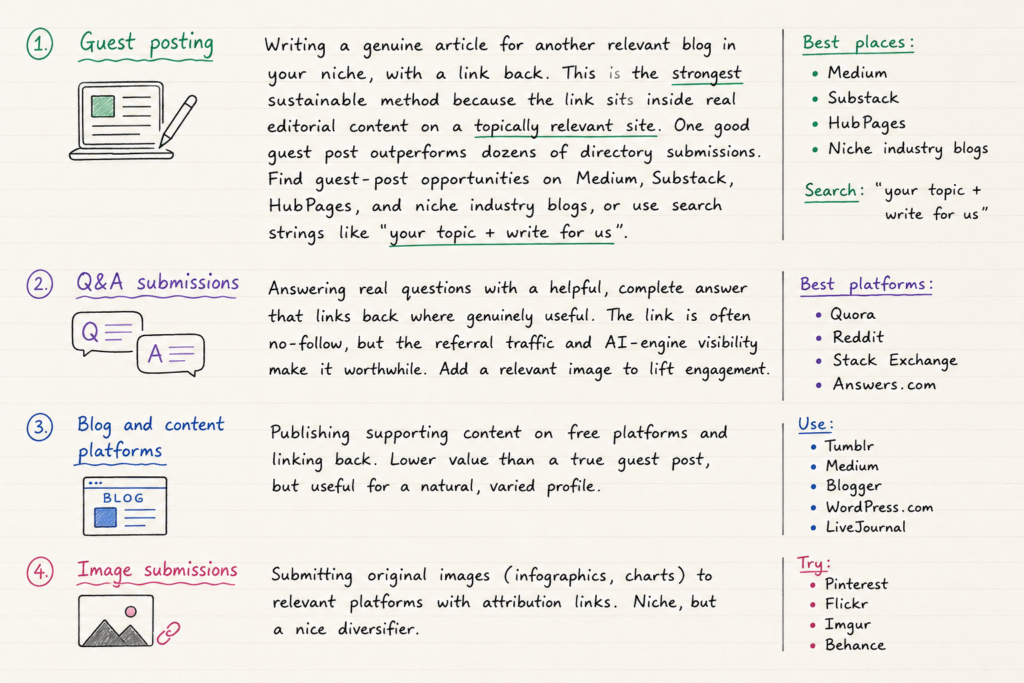
Blog and content platforms
Publishing supporting content on free platforms and linking back. Lower value than a true guest post, but useful for a natural, varied profile. Use Tumblr, Medium, Blogger, WordPress.com, and LiveJournal.
Image submissions
Submitting original images (infographics, charts) to relevant platforms with attribution links. Niche, but a nice diversifier. Try Pinterest, Flickr, Imgur, and Behance.
How do you syndicate a blog post to earn backlinks?
Syndication is republishing or distributing your post across other platforms so it reaches new audiences and picks up links and mentions. Done right, it turns one post into many entry points back to your site. Done carelessly, it can create duplicate-content confusion. Here’s the process that keeps it safe and useful:
- Publish on your own site first. Always let Google index the original on your domain before it appears anywhere else, so your site is credited as the source.
- Republish on owned platforms. Post an adapted version on Medium, Substack, LinkedIn Articles, Blogger, and Tumblr. Where supported, use a canonical tag pointing back to your original URL so search engines know which version is authoritative.
- Distribute in relevant communities. Share the post where your audience already is-Reddit, Quora Spaces, Facebook groups, LinkedIn feed posts, and industry newsletters — with a genuine summary, not just a dropped link.
- Repurpose into other formats. Turn the post into a short video, a carousel, an infographic, or an email. Each format is a fresh way for someone to discover and link to the original.
- Pitch it for guest features and roundups. If the post is strong, offer a tailored version as a guest article, or pitch it to roundup and newsletter curators in your niche for an editorial link.
- Track what earns links. Log which channels drive referral traffic and backlinks, and lean into the ones that work next time.
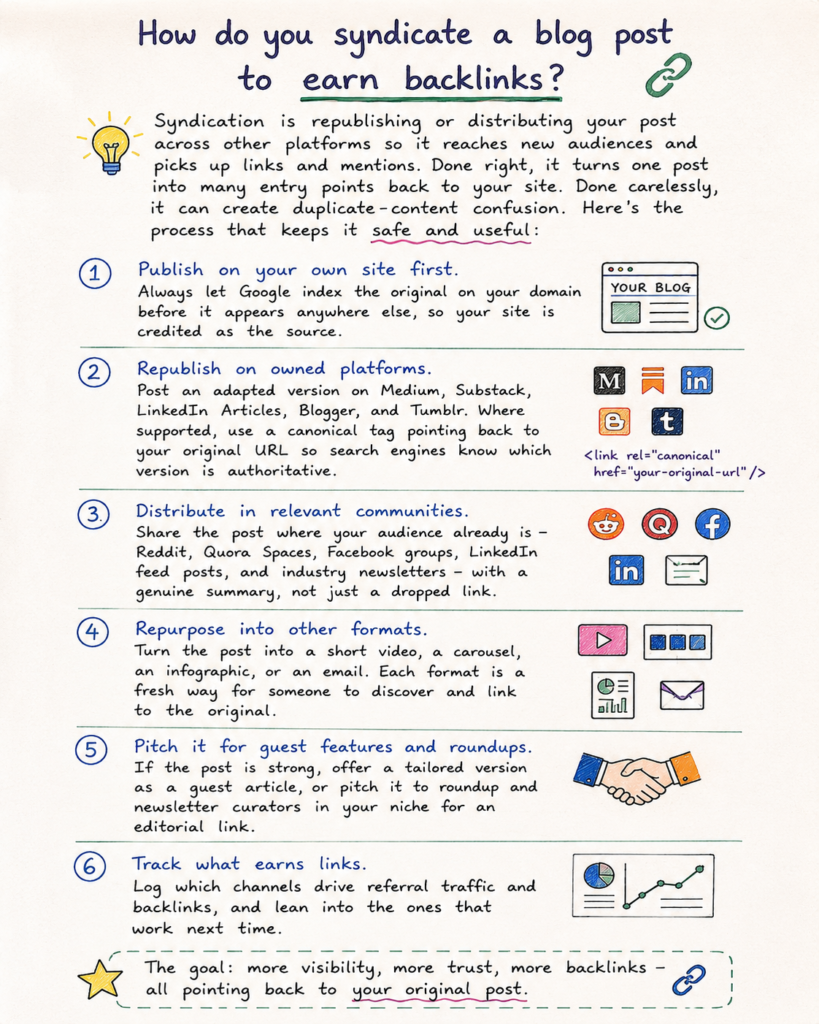
The rule underneath all of it: the original lives on your domain, everything else points back to it. That’s how syndication builds authority instead of splitting it.
How do you track your backlinks in a spreadsheet?
Once you start building links, you need one place to see them all-otherwise you lose track of what’s live, what’s pending, and whether your do-follow/no-follow mix is healthy. A simple spreadsheet does the job. If you build links for clients, this same sheet doubles as your proof of work. Set up these columns:
- Sno-a running serial number.
- Date-when you submitted the link.
- Website-the platform (Quora, Tumblr, Medium, etc.).
- Title-the question or post title where your link sits.
- Final Link-the exact live URL of your backlink.
- Status-Approved, Pending, or Rejected.
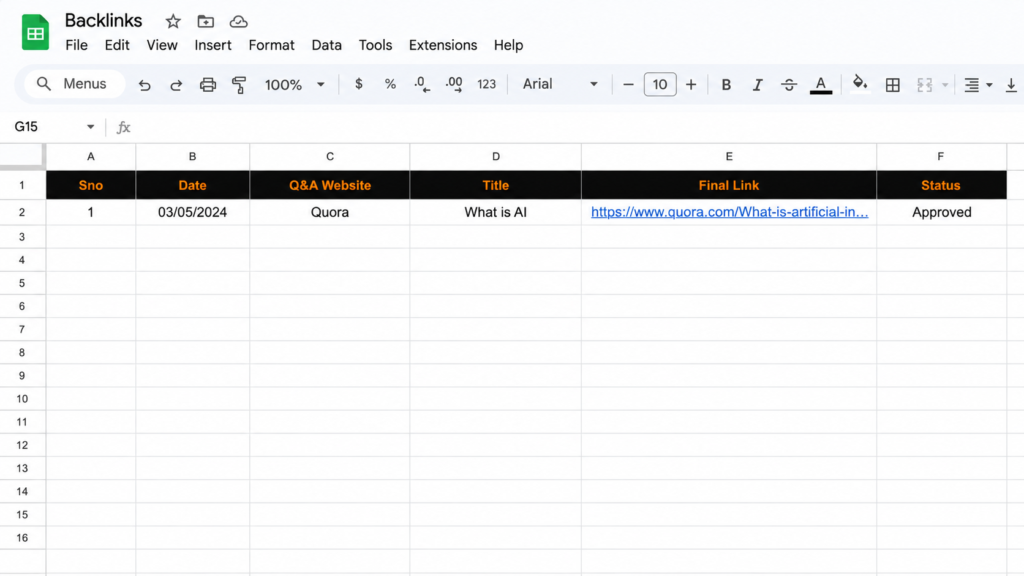
Add a Do-follow / No-follow column too, filled in using the Inspect check above, so you can see your ratio at a glance. Update the status as links go live, and review the sheet weekly. It turns link building from a scattered guess into something you can actually measure and repeat.
How do you build backlinks safely without a penalty?
The fastest way to undo good off-page SEO is to make it look bought. A few habits keep you safe:
- Earn links from sites relevant to your topic, not just any site that’ll take one.
- Keep a natural do-follow/no-follow mix instead of chasing do-follow only.
- Build links gradually — a sudden spike of hundreds of links looks manufactured.
- Track every backlink in a simple sheet: source URL, DA, do-follow or no-follow, date. If you do this for clients, that sheet is also your proof of work.
Does off-page SEO still matter in the age of AI answer engines?
More than ever. Tools like ChatGPT, Perplexity, and Google’s AI Overviews decide which sources to cite partly based on how trusted and widely referenced a site is across the web. Backlinks and brand mentions are exactly the signals that build that trust. So the off-page work you do to rank in classic Google search is the same work that gets your site pulled into AI-generated answers. Off-page SEO is now doing double duty for search and for answer engines at once.
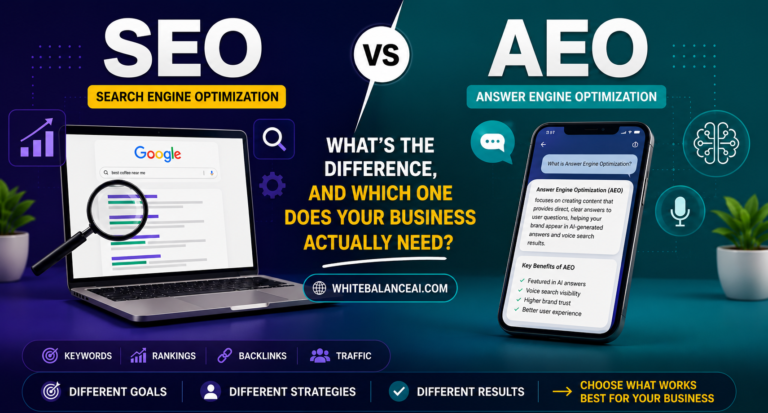
Read this in 2026 with SEO we need these – What is AEO ?
Frequently asked questions
How long does off-page SEO take to work?
Usually a few months, not weeks. Backlinks need time to be crawled and for search engines to register the trust they pass. A steady stream of quality links over three to six months does far more than a burst of many links at once.
How many backlinks do I need to rank?
There’s no fixed number — quality and relevance decide it, not quantity. A handful of links from trusted, topically relevant sites can outrank a competitor sitting on hundreds of weak ones.
Are no-follow links a waste of time?
No. They don’t pass ranking authority directly, but they send real referral traffic, get your brand in front of AI crawlers, and keep your backlink profile looking natural.
What domain authority should I look for in a backlink?
As a starting filter, aim for domains with a DA above 20 and raise the bar as your own site grows. Treat DA as a rough guide — relevance to your topic matters more than a slightly higher score.
Is guest posting still safe for off-page SEO?
Yes, when it’s genuine. A real, useful article on a relevant blog with a natural link back is one of the strongest and safest methods. What Google penalises is mass, low-quality guest posts written only to drop links.
⭐ Found this helpful? Add WhiteBalanceAI as your Google Preferred Source so my posts show higher in your results.
🌿 Want to see AEO in action?
Caloriematterss is a real-world niche food blog built with AEO (Answer Engine Optimization) and GEO (Generative Engine Optimization) principles from the ground up. Explore how structured recipes, FAQ schema, internal linking, and AI-friendly content work together in a live website.
Visit Caloriematterss →🚀 Starting your first website?
The platform you begin on shapes your speed, security, and how little you have to fight with later. The one I use and recommend is Hostinger — simple enough for a non-technical owner, runs WordPress cleanly, and handles the hosting essentials so you don’t manage servers.
Start with Hostinger →Disclosure: this is an affiliate link. If you sign up through it, I may earn a small commission at no extra cost to you. I only recommend tools I actually use and trust.
Want this handled for you?
Off-page SEO takes consistent, patient outreach-the kind that’s hard to fit around running a business. I build backlink profiles the safe way: relevant, gradual, tracked, and aimed at both Google and AI answer engines. If your site is technically fine but still not ranking, this is usually the missing piece.

One Comment
Comments are closed.